
AI needs data fit for purpose — supported by context, quality, governance and continuous readiness.
What Does It Take to Build and Maintain AI-Ready Data in Pharma?
From Gartner’s insights to a practical readiness assessment and managed data products.
Clean data is a starting point, not the finish line
Pharmaceutical organizations are exploring AI to accelerate research, improve operations, and support better decisions. Yet AI-ready data remains a fundamental challenge: how can organizations ensure that the data behind their AI initiatives is reliable, meaningful, and suitable for its intended use?
An accurate dataset is not necessarily ready for an AI application. Data may be complete, correctly formatted, and technically accessible, yet still lack the business context needed for reliable interpretation. This distinction matters particularly in pharma, where laboratory, quality, manufacturing, and enterprise systems hold different parts of the information required for analysis and decision-making.
The real challenge is not simply preparing data for AI. It is defining what makes data fit for a specific purpose—and maintaining that fitness over time.
What Gartner’s research means for AI readiness
Gartner’s 2026 research, Foundations of AI-Ready Data, highlights an important shift: treat AI data preparation as an ongoing activity, not a one-time effort. AI readiness requires ongoing attention to how data is aligned with intended use, qualified, and governed throughout its lifecycle.
This has practical implications. Instead of assuming existing high-quality datasets can support any AI application, organizations need to define what each use case requires. The same data may suit routine reporting but fall short for an AI application that needs additional context, different quality criteria, or more frequent updates.
A related Gartner perspective reinforces this direction. In its Top Trends in Data and Analytics for 2025, Gartner identifies highly consumable data products as an important trend, emphasizing reusable data assets designed around business-critical use cases. Gartner recommends developing minimum viable data products, aligning producers and consumers around success measures, and using business metadata to make data easier to understand and consume.
For pharmaceutical organizations, the practical lesson is clear: Start with a valuable use case. Define what suitable data means for that use. Then establish a repeatable way to deliver, govern, and maintain it.
Why context matters
Consider an analytical result stored in a Laboratory Information Management System (LIMS). The measurement may be accurate, correctly recorded, and available for reporting. But an AI application interpreting that result may also need to know:
- Which sample and batch the result belongs to.
- Which analytical method was used and which measurement units apply.
- Whether the result has been reviewed or approved.
- Whether the record has subsequently been corrected or updated.
Without this context, technically correct data can still lead to misleading interpretations.
For example, combining results generated using different analytical methods without accounting for those differences could produce a trend that appears meaningful but is not scientifically comparable. The challenge is not simply connecting systems. It is ensuring that downstream consumers can access the relationships, definitions, quality requirements, and status of the underlying evidence.
Data must be understandable and traceable before you can establish its suitability for a specific AI use.
A practical starting point: the 5-point AI-ready data check
Before launching a large-scale data preparation initiative, select one high-value use case and assess the data it depends on. These five questions can help identify the most important readiness gaps.
1. Purpose — Do we know exactly how the data will be used?
Identify the intended AI application, the business decision it supports, and the requirements the data must meet. A dataset suitable for a dashboard may not be suitable for automated analysis or model training.
2. Context — Can the data be interpreted correctly?
Check whether business definitions, units, source information, relevant relationships, and review status are available. Technical accessibility alone does not establish meaning.
3. Quality and traceability — Can we verify the evidence?
Define the quality criteria that matter for the use case. Determine whether users can trace records to their sources, understand transformations, and identify data quality issues.
4. Ownership — Who is responsible for the data?
Establish who maintains business definitions, approves changes, resolves quality issues, and decides whether the data remains suitable for its intended use.
5. Continuous readiness — What happens when something changes?
Consider what happens when a source system is updated, a new analytical method is introduced, business rules change, or previously approved records are corrected. How will affected downstream consumers be identified and informed?
If one or more answers are unclear, the organization has identified a useful starting point for improving readiness. The next step is to translate those gaps into concrete requirements: what data and context are missing, what quality controls are needed, who owns the data, and how changes will be managed. The objective is not to make every dataset AI-ready. It is to establish and maintain fitness for the use cases that matter.
From readiness assessment to managed data products
Identifying gaps is only the beginning. Organizations also need a practical way to turn the findings into reliable, reusable data assets. This is where managed data products can help. A managed data product is more than a dataset, pipeline, or automated export. It brings together the data, its business meaning, defined quality expectations, ownership, documentation, and mechanisms for ongoing delivery and management.
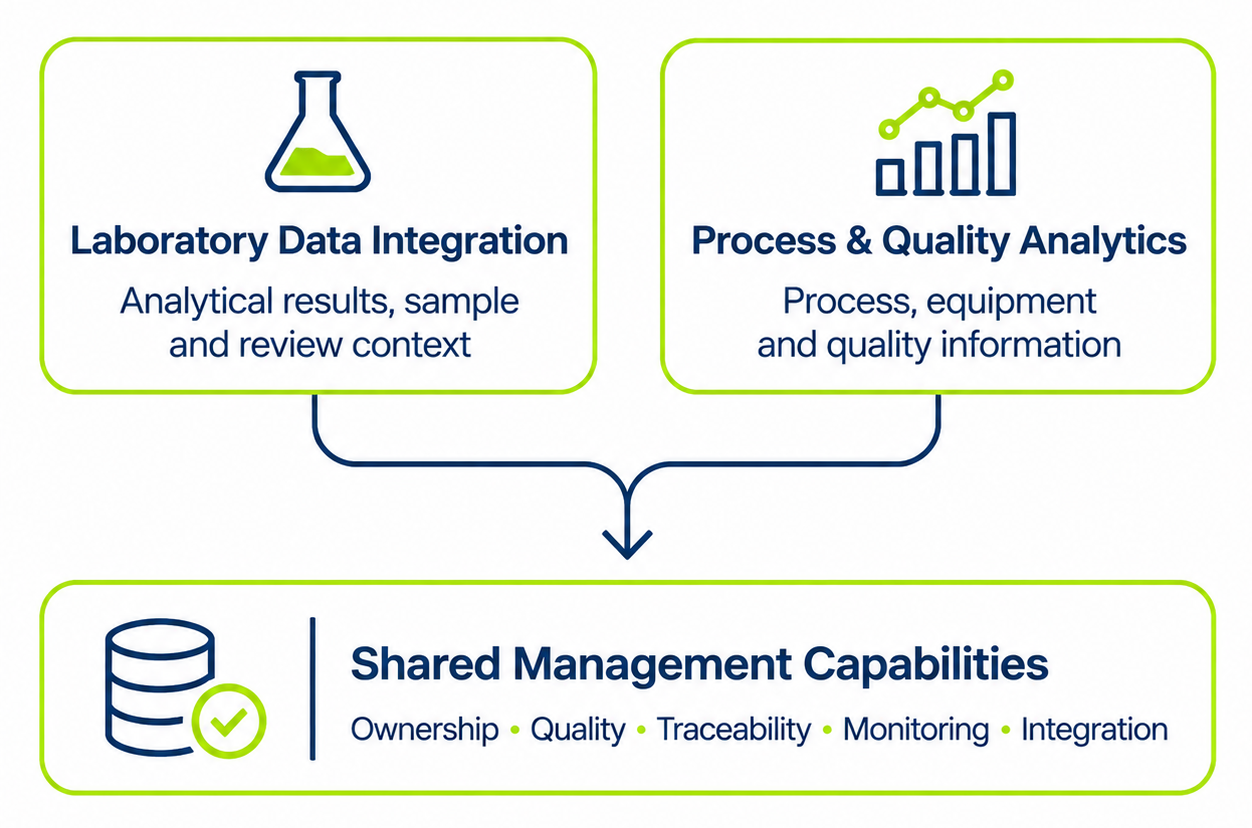
Two pharma data product examples supported by shared capabilities: ownership, quality, traceability, monitoring and integration.
In pharmaceutical environments, two practical examples illustrate how managed data products can support different business needs:
Laboratory Data Integration
A managed data product can bring analytical results together with sample information, method context, and review status. This provides a more consistent foundation for traceable reporting, cross-system analysis, and downstream applications.
Process & Quality Analytics
A data product can combine process, equipment, and quality information with agreed definitions and quality controls. This supports consistent monitoring, trend analysis, and operational decision-making.
Both examples rely on common management capabilities: ownership, quality controls, traceability, monitoring, and integration. Instead of rebuilding the same integrations and definitions for every new report or AI initiative, teams can maintain reusable data products and adapt them as requirements evolve.
However, a managed data product is not automatically AI-ready for every application. You must still assess its suitability against the requirements of each intended use.
A practical path to AI- ready data
Building AI-ready data capabilities does not require transforming the entire data landscape at once. A more practical approach is to begin with one business-critical use case and progress through three connected activities.
At Netica, we help organizations apply this approach to turn fragmented enterprise data into governed, reusable data products.
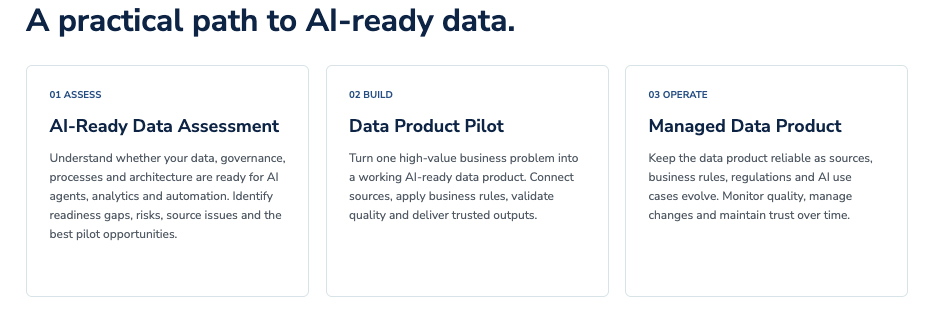
From AI-ready data assessment to a working data product pilot and continuous management — Netica’s Assess, Build, Operate approach.
Assess — Understand the requirements and gaps
Start by defining the business problem and the intended use of the data. Identify the required sources, business context, quality expectations, ownership, and downstream consumers. Evaluate what is already available and where the most significant gaps exist.
The outcome: a prioritized set of data requirements and readiness gaps for a specific use case.
Build — Deliver a first usable data product
Bring together the necessary data and context, establish agreed definitions and quality controls, and make the resulting product available to its intended consumers. Start with a manageable scope and measurable acceptance criteria rather than attempting to solve every data challenge at once.
The outcome: a reusable data product with defined quality expectations, ownership, and delivery mechanisms.
Operate — Maintain fitness for purpose
Once the data product is in use, monitor its quality, availability, and changes. Maintain ownership, assess the impact of updates, resolve issues, and refine the product as business requirements evolve.
The outcome: an actively managed data product whose suitability can be evaluated and maintained over time.
Neticin NetILab Framework supports this approach by bringing together data integration, quality, governance, and continuous management.
AI readiness is a capability, not a milestone
You can’t establish AI-ready data through a single cleansing exercise or integration project. It requires a clear understanding of intended use, the context needed for reliable interpretation, accountable ownership, and processes that help keep data suitable as sources and requirements change.
For pharmaceutical organizations, the most effective starting point is often a focused assessment of one valuable use case. The five questions outlined above provide an initial way to identify gaps. From there, organizations can prioritize improvements, build a first managed data product, and establish the practices needed to maintain it.
The goal is not simply to prepare data for AI today. It is to build the capability to keep data fit for purpose as business needs and AI applications evolve.
How AI-ready is your data?
Start with one high-value use case. Identify the gaps in business context, quality, traceability, ownership, and continuous management.
Book a Discovery Workshop to explore how Netica can help assess your data readiness and turn your requirements into a trusted, reusable data product.