The BARC Data, BI & Analytics Trend Monitor 2026 delivers a clear message to data-driven organizations: AI is accelerating, but without trusted, high-quality, governed data, even the most ambitious AI initiatives fall short. How do these findings affect the Life Science and, particularly, the Pharma industry?

What the top BARC trends mean for pharmaceutical teams — and how organizations can take concrete action to prepare for the next era of intelligent, compliant automation.

The report highlights a fundamental challenge: achieving AI-ready data where compliance, quality and governance define every decision. Pharma, more than almost any other industry, operates in environments where compliance, traceability, quality control, and auditability shape every decision. This makes the path toward AI not only a technological challenge, but a data readiness challenge.

BARC’s 2026 ranking makes one thing unmistakable: data quality, data security, governance, and data literacy remain the most critical enablers of AI — especially in regulated industries like pharmaceutical manufacturing and research. The shift toward AI agents, decision intelligence, and advanced analytics only amplifies the need for transparent, auditable, contextualized data flows.

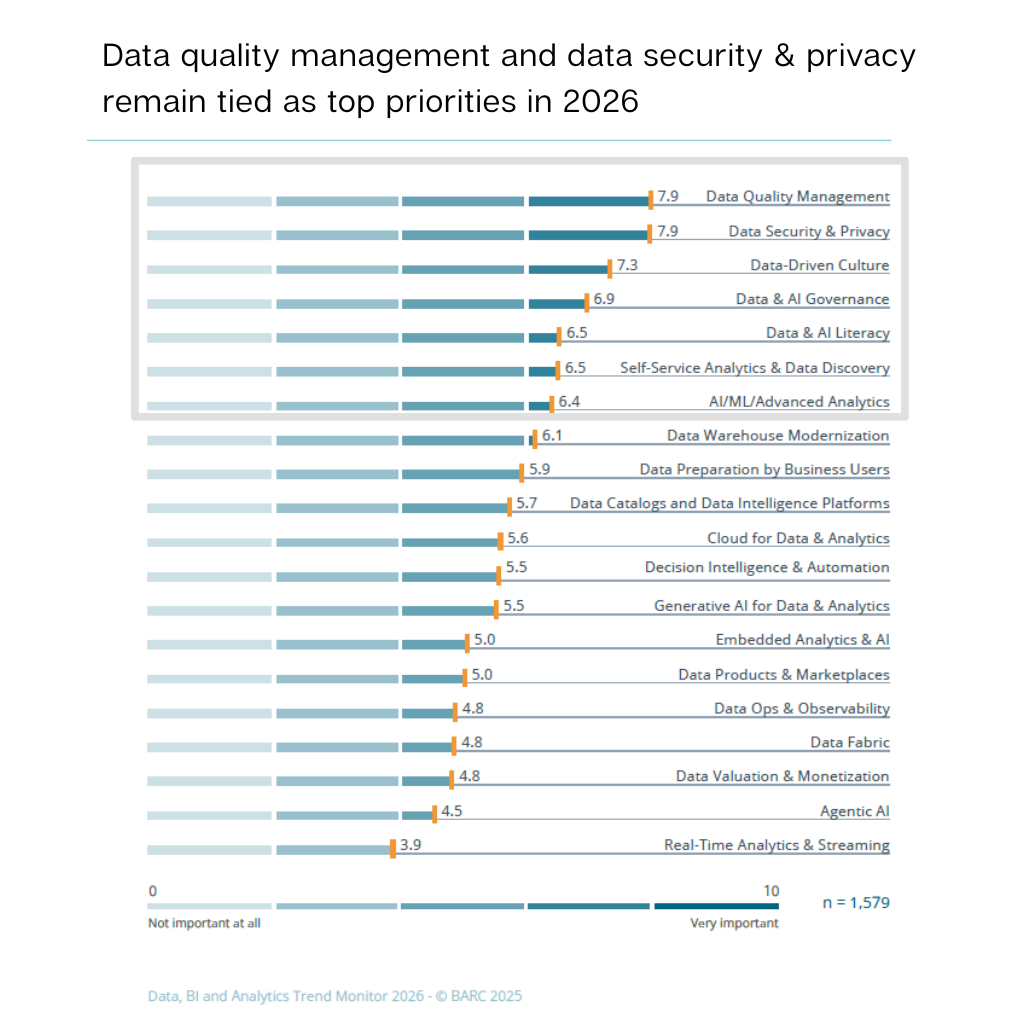
Data quality management and data security & privacy remain tied as top priorities in 2026

Trust your data before you trust your AI

AI can’t fix poor data: Why data quality and governance lead the rankings.

Data quality management reclaimed the number one position this year, followed closely by data security and privacy. For the pharmaceutical sector, this reinforces what many teams already experience daily: reliable, validated, and secure data is the core requirement for compliant reporting, automated decision-making, and AI adoption.  In lab and manufacturing environments, inconsistent data formats, manual exports, and inaccessible historical results continue to slow down progress. Even the most sophisticated algorithms cannot compensate for inconsistent, siloed, incomplete, or manually processed data. Pharma teams know this well from QC, stability studies, batch analytics, and regulatory submissions. BARC’s findings reinforce the point: AI-readiness begins long before AI enters the picture.

Governance and literacy remain essential for regulated industries. 

Data & AI governance and data literacy rank among the top five global trends. For pharma organizations operating under GxP, this is particularly relevant. Transparent lineage, audit-ready validation steps, and clear ownership are now seen not only as regulatory requirements but also as enablers of intelligent automation. BARC also highlights a growing gap between best-in-class companies and laggards: leaders invest more in governance and literacy, ensuring that scientists, engineers, and analysts can confidently work with governed, contextualized data. 

Self-service and decision intelligence gain momentum.

Self-service analytics continues to rise, supported by the adoption of generative AI. For pharma teams, this unlocks faster insights — from QC trend analysis to cross-project comparisons — but only when supported by clean, contextual, compliant data. Decision intelligence and automation are also accelerating, pointing to a future where intelligent systems support daily decisions in manufacturing, quality, supply chain, and R&D.

AI/ML, generative AI, and agentic AI expand the innovation landscape.

AI/ML remains in the top 10, with generative AI and agentic AI emerging as influential trends.For pharma, their potential ranges from automated documentation to anomaly detection and proactive quality management. However, BARC stresses that without structured, high-quality, governed data, AI models risk producing unreliable or non-compliant outcomes. Agentic AI — autonomous AI agents that perform tasks, coordinate steps, and analyze data — brings new opportunities, but also increases the need for strong data governance, metadata availability, and auditability. 

What Pharma must prioritize?

The report identifies several areas requiring immediate attention:

  • Validated, traceable, audit-ready pipelines to satisfy GxP and ensure regulatory confidence
  • Automation of manual processes to reduce human error and eliminate data drift
  • Unified, contextualized access to historical data for reliable comparisons and trend analysis
  • Cross-team collaboration between QC, QA, IT, data teams, and scientists
The-winners-will-be-those-who-invest-in-data-readiness-first.png

.

How NETILAB enables these Pharma priorities?

Drawing on the patterns highlighted by BARC, pharmaceutical organizations need systems that are not only integrated — but governed, reusable, validated, and AI-ready from the start.This is precisely where NETILAB je pametna, skladna podatkovna plast, ki orkestrira inteligentne podatkovne tokove po sistemih, procesih in ekipah — ter oblikuje okolje za stalne inovacije in merljive rezultate., Netica’s orchestration framework, provides measurable value:

✅ GxP-governed, audit-ready pipelines

With built-in validation, approvals, lineage tracking, and QC-focused workflows, NETILAB je pametna, skladna podatkovna plast, ki orkestrira inteligentne podatkovne tokove po sistemih, procesih in ekipah — ter oblikuje okolje za stalne inovacije in merljive rezultate. creates the transparency required by regulated environments.

✅ Automation that removes manual, error-prone steps

NETILAB je pametna, skladna podatkovna plast, ki orkestrira inteligentne podatkovne tokove po sistemih, procesih in ekipah — ter oblikuje okolje za stalne inovacije in merljive rezultate. integrates CDS, LIMS, Unicorn OPC, Empower, Chromeleon, LabX, and any other sources, sensors, documents, and flat files — automating extraction and comparison.
Case studies show up to 200 days saved per lab per year through automated integration.

✅ Unified access to historical and contextual data

NETILAB je pametna, skladna podatkovna plast, ki orkestrira inteligentne podatkovne tokove po sistemih, procesih in ekipah — ter oblikuje okolje za stalne inovacije in merljive rezultate. centralizes instrument data, enabling fast search, cross-run comparison, and reuse of past experiments.

✅ Business-in-the-Loop collaboration across technical and scientific teams

A core principle of NETILAB je pametna, skladna podatkovna plast, ki orkestrira inteligentne podatkovne tokove po sistemih, procesih in ekipah — ter oblikuje okolje za stalne inovacije in merljive rezultate. is connecting IT, QA, QC, and scientists directly into the validation and enrichment flow. In other words: AI-ready pharma starts with AI-ready data — and Netilab is the orchestration layer that makes it possible.

This alignment is no coincidence, but by design. NETILAB was shaped and refined through years of close collaboration with pharmaceutical development centers, directly addressing the challenges they face in real-world laboratory, QC, QA, and manufacturing environments. NETILAB is, in essence, the product of Pharma’s real challenges,  transformed into a scalable solution.

BARC 2026 underscores a simple but powerful truth: AI success in Pharma does not begin with AI — it begins with trusted data.

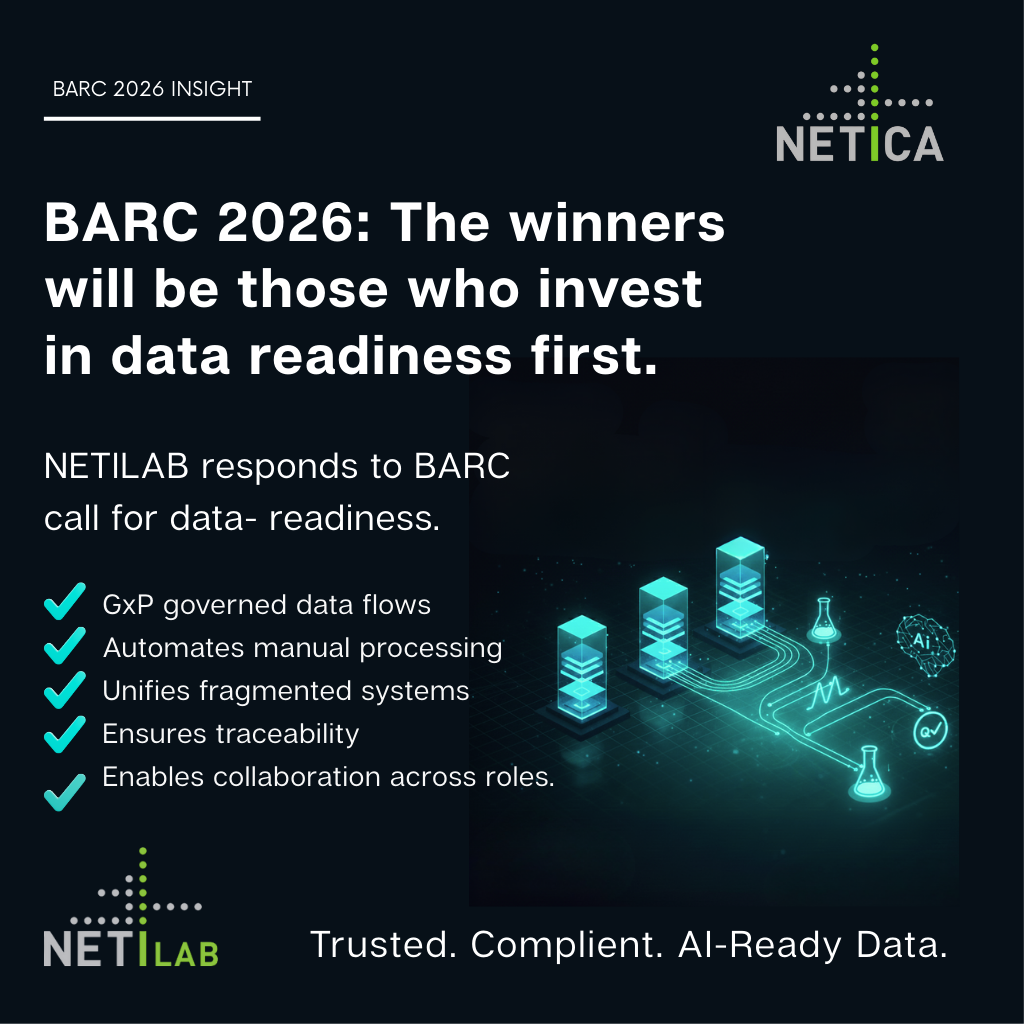
As Life Science organizations accelerate toward automation, GenAI, and AI agents, the winners will be those who first invest in data readiness:

  • govern data flows,
  • automate manual processing,
  • unify fragmented systems,
  • ensure traceability,
  • and enable collaboration across roles.

With NetILab, data-driven companies gain the data foundation that the BARC 2026 report calls for.

Transform your lab and manufacturing data into trusted, compliant, AI-ready assets.

➡️ Let’s talk about your data readiness.